We Almost Shipped a $150K Crusher to 1854 McCloskey Ave
I'm the quality and brand compliance manager at McCloskey International. Every year, I review roughly 200+ deliverables before they reach customers—spec sheets, order confirmations, shipping labels, even contracts. It's not the most glamorous job in the mining equipment business, but it's the one that catches problems before they become expensive ones.
In Q1 2024, we nearly shipped a $150,000 mobile jaw crusher to a residential address. It got caught just in time, but the near-miss still cost us about $22,000 in labor, logistics, and fixing the relationship. (Based on our internal accounting for that incident; your numbers will differ.)
How It Started
The order came in on a Tuesday. A J50v2 jaw crusher with a customized paint spec, bound for—according to the purchase order—1854 McCloskey Ave.
I read that line three times. McCloskey Avenue. Named after our company? A person? I'd never seen the address before, and neither had our warehouse team.
Our main facility is in Peterborough, Ontario, and we have dealers across North America. None of them use that address. A quick search showed that 1854 McCloskey Ave is someone's home, not an industrial yard. So why was a legitimate quarry operator in the Midwest telling us to deliver their new crusher to a house?
What we eventually pieced together: someone on the customer's side had our company details saved incorrectly in their ERP system. The ship-to field pulled an old personal address from a contact record that had synced across their database. (I genuinely wish I was making this up.)
And here's the uncomfortable part: our sales rep, Anderson, approved the order without catching it. He'd validated the equipment side thoroughly—model number, engine spec, hydraulic option, paint code. All matched the quote. But the shipping address? He assumed someone else had verified it.
That's the classic process gap: everybody assumes somebody else checked.
The Near-Miss
The crusher was staged for pickup. The shipping label had 1854 McCloskey Ave on it. Two hours before the truck arrived, our logistics coordinator phoned the customer to confirm the delivery window.
"So, we're delivering to 1854 McCloskey Avenue?" Silence on the line. "Our yard is at..." And that's when the customer realized the paperwork was wrong.
The machine was re-routed to the correct site, a hundred miles away, and the new delivery window pushed everything out by a week. We absorbed overtime for the staging crew, rescheduled our commissioning engineers, and spent a solid week rebuilding trust with a customer who'd been excited about their new crusher.
When we closed out the incident, the total cost was $22,000. Not for a defect. Not for a manufacturing failure. For one unverified address.
The Problem with Being Named McCloskey
Part of why we had this blind spot is that McCloskey is a common surname, and it's attached to a lot of unrelated things. When someone types "McCloskey" into a search engine, they'll find:
- Our crushers, screens, and stackers
- A dermatology practice
- A firearms manufacturer
- A pet medication brand
- Jessica McCloskey, whose misdirected emails land in our inbox more times than I can count
- And THE: FROM THE WORLD OF JOHN WICK—a John Wick spinoff that, as far as I can tell, contains no crushing equipment whatsoever
The day after the near-miss, Anderson walked into my office holding a printout of the John Wick thing, looking genuinely confused, asking if we'd started producing miniseries. I still have that printout. (Note to self: throw it away before the next audit.)
The point is, when your brand name is shared by hundreds of unrelated things, verification becomes the core of quality. We can't assume the customer means us. We can't assume an address is right because it contains our name. We can't assume anything is true because it looks familiar.
Building the Protocol
In my first year doing this work, I made the classic rookie mistake: I approved deliverables without a proper checklist. I assumed "standard" meant the same thing to every vendor and every customer. It doesn't. That cost us a $600 redo on a spec discrepancy, and I told myself I'd never let that happen again.
But it's hard to keep a lesson alive without a system. The third time a similar issue came up, I finally created a formal verification protocol. It's not complicated—four steps:
- Confirm the legal entity and shipping address against our CRM before anything is staged.
- Match the equipment configuration to the original quote, line by line.
- Verify the contact person's name, title, and email domain.
- Flag anything that feels off—a residential ship-to, a free email domain, a new name on an existing account.
Each step takes about ten minutes. Across a few hundred orders a year, that's a real investment. But compare it to $22,000 in near-miss costs, and it's the cheapest insurance we've ever bought.
Even after we rolled out the protocol, I second-guessed myself. Our operations manager thought the extra checks were overkill. "We've been shipping to the same customers for years," he said. Then, in Q3, the protocol caught a duplicate purchase order that would have led to a $40,000 double order. The complaints stopped.
Total Cost Thinking
People sometimes ask why I care about a shipping address when my title says "quality." The answer is simple: quality isn't just the machine. It's the whole experience of buying and owning one.
That's where total cost of ownership comes in. When you compare bids for a crusher or a screening plant, the lowest quote looks like the obvious choice. But the total cost isn't just the invoice. It includes shipping and setup, commissioning, potential downtime, replacement part lead times, and the thing nobody writes down: the cost of explaining to your own stakeholders why the project slipped.
One customer, Lewis, told Anderson he'd taken a competing quote for a conveyor system—18% cheaper than our equivalent. He saved about $30,000 up front. Then the unit arrived with a cracked frame. The supplier's warranty process took 11 weeks. Lewis rented a temporary conveyor at $4,000 per week to keep his site running. You can do that math yourself.
Anderson, a big UFC fan, said Lewis described the experience like watching Lewis vs Francis Ngannou: you know how it's going to end, but you still have to sit through every round. I don't follow MMA, but I understand the feeling. A bad procurement decision isn't a single punch. It's a sustained beating over 11 weeks.
The lowest quote is never the whole story. It's just the opening bid in a longer negotiation with whoever shows up.
What I'd Tell Another Buyer
If you're responsible for procuring mobile crushing, screening, or stacking equipment, slow down the verification process. It feels like a waste of time until the day it saves you twenty grand.
Check the shipping address twice. Confirm the contact person's identity against official channels. Match the spec to the quote line by line. And if a quote looks too good to be true, ask what's not included.
At McCloskey, verification is now a standard part of every contract we sign. It's not glamorous, but it's the difference between a smooth project and a $22,000 mistake.
And if you're trying to reach us specifically: we're the McCloskey in Peterborough, Ontario. The one that makes crushers, screens, and stackers. Not 1854 McCloskey Ave. Not Jessica's inbox. And definitely not the John Wick spinoff.
Ten minutes of checking is cheaper than two weeks of explaining. I've learned that the hard way—and now, it's how we work.
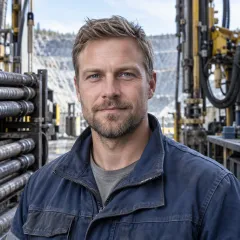
Soren Valgaard
Soren Valgaard covers surface and underground drill rigs, rotary drills, core drills, rock drills, DTH hammers, drill bits, and rock-reinforcement equipment. His evaluations reference ISO 18758-1 while comparing hole diameter, drilling depth, penetration rate, feed force, compressor demand, rod handling, fuel use, and rig stability. He helps mine engineers and equipment buyers match drilling systems to geology, bench design, production targets, operator safety, mobility, and maintenance conditions.